India and Russia to boost strategic ties as trade pressure from US grows
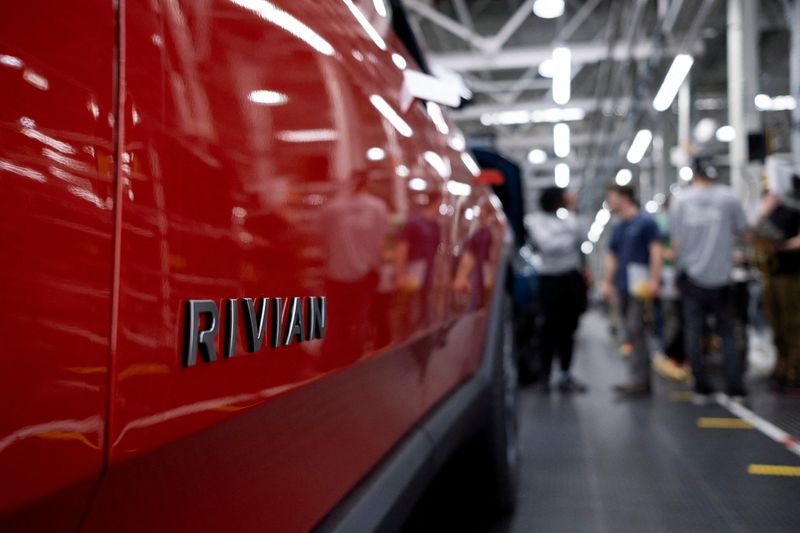
Rivian Automotive Inc. reported its third-quarter 2025 earnings, revealing a narrower-than-expected loss per share (EPS) at -$0.65, beating the forecast of -$0.74. The company’s revenue also surpassed expectations, reaching $1.6 billion against a forecast of $1.52 billion. Despite these positive results, Rivian’s stock fell by 5.23% in after-hours trading, closing at $12.93, down from the previous close of $13.19.
Key Takeaways
- Rivian’s EPS loss was less than anticipated, indicating improved financial performance.
- Revenue exceeded forecasts, reflecting strong sales and operational execution.
- The stock declined in after-hours trading, possibly due to broader market conditions or investor concerns about future guidance.
- Rivian’s cash position remains robust at $7.1 billion, supporting future growth initiatives.
- The company is on track with its R2 vehicle launch, planned for early 2026.
Company Performance
Rivian demonstrated solid performance in Q3 2025, with revenues hitting $1.6 billion, driven by strong vehicle deliveries totaling 13,201 units. The company continues to lead in the premium SUV market, particularly in California, and is focusing on expanding its market share in the underserved mass-market EV segment.
Financial Highlights
- Revenue: $1.6 billion, exceeding forecasts and reflecting a strong sales quarter.
- EPS: -$0.65, better than the anticipated -$0.74.
- Gross Profit: $24 million, indicating a positive margin despite operational losses.
- Adjusted EBITDA Losses: $602 million, in line with strategic investment plans.
- Cash Position: $7.1 billion, ensuring financial stability and growth potential.
Earnings vs. Forecast
Rivian’s actual EPS of -$0.65 beat the forecast of -$0.74, representing a positive surprise of 12.16%. The revenue of $1.6 billion also surpassed the expected $1.52 billion, marking a 2.63% surprise. These results highlight Rivian’s effective cost management and operational efficiency improvements.
Market Reaction
Despite the earnings beat, Rivian’s stock fell by 5.23% in after-hours trading. The decline could be attributed to broader market trends or investor concerns about future profitability and guidance. The stock’s current price is $12.93, within its 52-week range of $9.50 to $17.15.
Outlook & Guidance
Rivian maintains its delivery guidance for 2025 at 41,500-43,500 units and expects adjusted EBITDA losses between $2.0 billion and $2.25 billion. Capital expenditures are projected to be $1.8-$1.9 billion. The company plans to launch its R2 vehicle in early 2026, aiming for positive unit economics by the end of that year.
Executive Commentary
CEO RJ Scaringe emphasized the company’s commitment to producing high-quality vehicles, stating, "We’re building the best car you can buy in this category and at this price point." CFO Claire McDonough highlighted the focus on efficiency, remarking, "Our philosophy has always been to drive efficiencies into the business to help self-fund strategic areas of differentiation."
Risks and Challenges
- Potential demand softness following the expiration of the IRA credit could impact sales.
- Macro-economic pressures and market saturation in the EV segment pose risks.
- Supply chain disruptions may affect production timelines and costs.
- Competitive pressures from established players like Tesla remain significant.
- Achieving positive unit economics for the R2 by 2026 is crucial for long-term profitability.
Q&A
During the earnings call, analysts questioned Rivian’s ability to manage costs and maintain growth amid potential demand fluctuations. The company expressed confidence in its cost structure and strategic partnerships, such as with Volkswagen, to mitigate these challenges.
Full transcript - Rivian Automotive Inc (RIVN) Q3 2025:
Earnings Call Moderator, Rivian: Good afternoon, and thank you for joining us for Rivian’s third quarter 2025 earnings call. Today I’m joined by RJ Scaringe, our CEO and founder, Claire McDonough, our Chief Financial Officer, and Javier Varela, our Chief Operating Officer. Before we begin, matters discussed on this call, including comments and responses to questions, reflect management’s views as of today. We will also be making statements related to our business, operations, and financial performance that may be considered forward-looking statements under federal securities law. Such statements involve risks and uncertainties that could cause actual results to differ materially. These risks and uncertainties are described in our SEC filings and the shareholder letter we have filed with the SEC. During this call, we will discuss both GAAP and non-GAAP financial measures. A reconciliation of historical non-GAAP to GAAP financial measures is provided in our shareholder letter.
Just before the earnings call, we published and filed our shareholder letter, which includes an overview of our progress over the recent months. I encourage you to read it for additional details around some of the items we will cover on today’s call. Following our prepared remarks, we will be taking questions from sell-side analysts. In the interest of keeping the call to one hour, we would ask these analysts to limit any follow-on questions to one. With that, I’ll turn the call over to RJ.
RJ Scaringe, CEO and Founder, Rivian: Thanks, Jiten. Good afternoon, everyone, and thanks for joining us for today’s call. We continue to make progress against our key strategic priorities, including preparation for the launch of R2 and development of our technology roadmap, including autonomy and our vertically integrated hardware and software. As we’ve stated before, over the long term, we expect the industry to be fully electric, autonomous, and software-defined. I’ve never been more confident in the opportunity ahead for Rivian than I am today. I firmly believe Rivian’s technology, along with our direct-to-consumer ownership experience, positions our company to build a category-defining brand with a strong product portfolio for the U.S. and European markets. One of the key drivers for attracting customers to electric vehicles, and to Rivian’s products more specifically, is consumer choice and price point.
The average new vehicle purchase price in the United States is now just over $50,000, and the most popular configuration is a five-seat SUV or crossover. Given the attractiveness of this addressable market, I believe R2 is addressing the largest market opportunity with the right product. We leveraged the performance, utility, and personality of R1 and refactored it into a smaller SUV at a lower cost. From an R&D perspective, our teams are executing well to ensure the development of R2 remains on track with our plans. We continue to increase the quality and maturity of our design validation builds, positioning us to begin manufacturing validation builds at year-end, following the full commissioning of production equipment. We recently completed the construction of our 1.1 million sq ft R2 body shop and general assembly building, and our 1.2 million sq ft supplier park and logistics center.
All shops have started equipment bring-up, and we are in the process of commissioning the robots in the R2 body shop. In addition, we have completed updates to our paint shop that will allow us to increase our total annual plant capacity to 215,000 units. I’ve been driving an R2 for a while now, and it is incredible. From a performance perspective, it delivers on the adventurous spirit customers expect from Rivian, while also being a great daily driver that will fit so many different use cases for our customers. Looking longer term, we expect to add an additional 400,000 annual units of capacity for R2, R3, and associated variants with our next U.S. manufacturing facility in Georgia. In September, we are honored to be joined by state and local officials for a groundbreaking ceremony.
Our significant investment in the state of Georgia is expected to create 7,500 jobs, as well as billions of dollars of economic benefits to the local community as we expand our U.S. manufacturing and technology footprint. In parallel to the progress we’ve made in developing R2, we’ve also continued to invest in our technology, including our hardware, our software, and our autonomy platform. I’m excited to share the progress we’re making at our upcoming Autonomy and AI Day on December 11th. Over the longer term, we believe what will differentiate Rivian’s autonomous capabilities will be our end-to-end AI-centric approach. With the launch of R2, our growing fleet of customer vehicles will collect real-world driving data, which will complement the data already collected by our second-generation R1 vehicles.
That data can be used to train our large driving model, which we believe will allow a rapid rollout of updating driving inference models with growing capabilities. In closing, as we look towards 2026, I’m excited about the opportunity ahead for Rivian. I believe our technology and our products will position Rivian as a market share leader over the long term. I want to thank our employees, customers, partners, suppliers, communities, and shareholders for their continued support. With that, I’ll pass the call over to Claire.
Claire McDonough, Chief Financial Officer, Rivian: Thanks, RJ, and good afternoon, everyone. As RJ mentioned, we continue to make progress on our priorities, and I want to thank our team for their continued focus as we drive execution throughout the business. While we face near-term uncertainty from trade, tariff, and regulatory policy, we remain focused on long-term growth and value creation. It’s great to see the continued progress in R2 validation and testing. We’re also excited to share more about our hardware and software roadmap and vision in December at our Autonomy and AI Day. Turning to the results for the third quarter, our consolidated revenues were approximately $1.6 billion, and consolidated gross profit was $24 million. Gross profit included $125 million of depreciation and $24 million of stock-based compensation expense. Adjusted EBITDA losses for the third quarter were $602 million. As expected, we saw quarter-over-quarter step-up in overall operating expenses.
This was driven by elevated R&D investments related to prototyping as we prepare for the launch of R2 and training costs for our autonomy platform. SG&A stepped up primarily related to the growth of our sales and service infrastructure and team, as well as operating expenses we don’t anticipate will be part of our ongoing cost structure. Now, looking at our automotive segment, during the third quarter, we produced 10,720 vehicles and delivered 13,201 vehicles from our manufacturing facility. As we’ve said previously, we expect Q3 will be our highest delivery quarter for the year, which was the primary driver of the $1.1 billion of automotive revenue. Automotive gross profit in the third quarter was negative $130 million and was negatively impacted by low fixed cost absorption associated with planned shutdown to prepare the Normal plant for R2.
Despite this headwind, we saw strong progress in our unit economics with one of the best quarters ever in automotive cost of goods sold per unit delivered, driven by improved material costs. Our software and services segment reported another strong quarter with $416 million of revenue and $154 million of gross profit. About half of the revenue within software and services was a result of the software and electrical hardware joint venture we created with Volkswagen Group. We also experienced strong growth and gross profit contribution from remarketing and vehicle repair and maintenance. Looking at our balance sheet, we ended the quarter with approximately $7.1 billion of cash, cash equivalents, and short-term investments. We continue to see improvements in our working capital, primarily driven by our focus on reducing our raw material, work-in-progress, and finished goods inventory levels.
We continue to expect to receive additional capital of up to $2.5 billion associated with our Volkswagen Group joint venture transaction, $2 billion of which we expect to receive in 2026. Additionally, we continue to partner with the Department of Energy for an up to $6.6 billion loan at a favorable cost of capital. We will update the market as we progress on this important project for the company. Finally, for our guidance, we are reaffirming our 2025 delivery guidance range of 41,500-43,500 units. We are reaffirming our 2025 Adjusted EBITDA loss guidance range of $2 billion-$2.25 billion. And 2025 capital expenditures guidance of $1.8 billion-$1.9 billion. We continue to expect our gross profit for the full year of 2025 to be roughly break-even. Thank you again to the team for delivering a great quarter.
As we near the end of the year, we look forward to 2026 and remain steadfast in our belief that R2 and our technology roadmap will be truly transformative for our growth and profitability. I’d like to turn the call back over to the operator to open the line for Q&A.
Q&A Moderator, Rivian: For the Q&A section of today’s session, we will be utilizing the raise hand feature. If you would like to ask a question, click on the raise hand button at the bottom of the screen. Once prompted, please unmute yourself and begin with your question. As a reminder, we ask that you stick to one question and one follow-up. We will now pause a moment to assemble the queue. Thank you. Our first question comes from Emmanuel Rosner, Wolf Research. Emmanuel, your line is open. Please feel free to unmute yourself and ask your question.
Great. Thank you so much for taking the question. My first one is on. Curious if you could characterize the demand environment in the U.S. that you’re experiencing on the back of the removal of the consumer tax credit. Obviously, a big portion of industry reports monthly sales, and did so yesterday. And for those that are involved in the EV business, there was quite a bit of a drop September into October. So just curious what you’ve seen and then sort of like level of comfort around the demand levels on a go-forward basis.
RJ Scaringe, CEO and Founder, Rivian: Thanks, Emmanuel, for the question. We certainly expected to see a pull forward of demand from October into September with the end of the IRA program, and we saw that in September. And that pull forward, of course, results in somewhat of a softer demand environment as we look at October. And I think that’s, as you referenced, I think that’s true just across the full space, across the industry, across multiple different manufacturers. I think it’s important, though, that we look out from a longer-term horizon point of view and recognize that ultimately, customers are going to be making decisions around what’s the best product for them. And we spend a lot of time, I think, often overly focused on electric vehicle sales relative to others.
And the way we think about this, in particular with regards to R2, is we need to build the best vehicles and give customers great choices. And so in the case of R1, we have the best-selling premium SUV sold in the United States, and that’s for EVs, premium SUVs, and we have the best-selling SUV, electric or non-electric in the state of California. And with R2, we’re really hoping to capture the magic of what is in R1 in terms of performance, features, capabilities, and a much more cost-effective or affordable package that allows us to have this vehicle be cross-shopped with so many different types of vehicles. And it’s hitting the most popular segment with midsize SUV, five-passenger SUV, with a price point that starts at $45. The average price of a new vehicle sold in the United States is around $50.
So we’re really bullish, really confident on R2 and what that represents for us as a business.
Okay, great. And then, as a quick follow-up, what are you expecting in terms of demand for regulatory credits? I don’t believe you’re assuming any additional sales this year, but any directional view into 2026?
Claire McDonough, Chief Financial Officer, Rivian: Thanks, Emmanuel. We don’t expect to have meaningful revenues from the sale of regulatory credits, and we’ve taken those out of our forecast. Just given some of the uncertainty on potential policy changes, we wanted to make sure that our forecast was conservative on this front.
Great, thank you.
Q&A Moderator, Rivian: Thank you. Our next question comes from Mark Delaney with Goldman Sachs. Mark, your line is open. Please feel free to unmute and ask your question.
Yes, good afternoon. Thank you very much for taking the question. COGS for car, meaningfully, I think it came down to about $96,000 per vehicle, even with the downtime the company takes to get the Normal site ready for R2. I think, Claire, you mentioned material costs as one of the key drivers of that, but I was hoping you could speak a bit more on what you’re seeing in terms of COGS per vehicle. I guess ultimately, any change in where you think costs can get to, especially as you look out to R2.
Claire McDonough, Chief Financial Officer, Rivian: Thanks for the question, Mark. As you noted, we had about $96.3K of cost of goods sold per unit delivered in Q3. And that was despite the fact that we had several weeks of downtime, so there was an impact from fixed cost absorption included within these results. As we look forward, the big driver of performance improvement in terms of our cost of goods sold in 2026 will be the volumes that we’ll receive from R2’s ramp and scaling efforts. So we’ll see benefit not just with R2’s path to positive gross profit and positive unit economics, which we expect to achieve by the end of 2026, but also the volume impacts that will benefit both R1 as well as our commercial vans as volumes scale throughout the Normal facility as a whole.
Thanks, Emmanuel. My other question was on Mind Robotics. You mentioned doing work with Mind Robotics, but also bringing in external financing. So maybe just talk a bit more about what Mind Robotics does and what kind of opportunity you see for the entity going forward. Thank you.
RJ Scaringe, CEO and Founder, Rivian: Yeah, Mark, this is an area we’ve spent a lot of time on as a company thinking around. And thinking about, I should say, what does our manufacturing infrastructure and manufacturing platforms look like long-term? And as we’ve thought through that, it led us to the view that we need to develop products and robotic solutions that can allow us to run and operate our manufacturing plants more efficiently. And the design of these robotic solutions, capturing the data that we have within our existing facilities to train the robotic platforms on manufacturing and to train on some of these high dexterity operations. And so we’ve ultimately raised $110 million in a seed round to launch this as an effort outside of Rivian, but obviously with Rivian still as a close partner and as a shareholder in this entity.
But the applications will include Rivian applications, but also much wider ranging. So thinking about essentially a wide spectrum of industrial applications where we see the benefit of AI-enabled robotics.
Q&A Moderator, Rivian: Thank you. Our next question comes from George Giannaricus with Canaccord. George, your line is open. Please feel free to unmute and ask your question.
Hi everyone. Thank you so much for taking my questions. Maybe you could just update us a little bit on the Volkswagen relationship, just because there are lots of headlines as to what’s going on there internally. Any update there would be very much appreciated. Thank you.
RJ Scaringe, CEO and Founder, Rivian: The Volkswagen relationship, coincidentally, is coming up in terms of the joint venture on the one-year anniversary. A lot has happened in the last year. We continue to make great progress. We have an incredibly productive and strong relationship with Volkswagen Group. I was just in Munich a few months ago for a number of different product reveals, one of which was the Volkswagen ID.1, which is a roughly $22,000 EV that’s being developed by Volkswagen, and of course, leveraging our technology platform, and it’s just an awesome vehicle.
I’m really excited for that to be one of the launch vehicles that comes out of our collaboration and joint venture with Volkswagen, but it’s the first of what will be many programs that come out of this joint effort, and so the relationship remains very strong, very positive, and there are lots of things to come in front of us in terms of products and other ways we can work together.
Thank you. And maybe as a follow-up, I don’t mean to front-run the autonomy day in December, but what role do you see Rivian playing in the robotaxi market? There are some of your peers also developing electric vehicles that have teamed up with some of the rideshare companies. Any sort of anything you could share on that front? Thank you.
I mean, a lot of emphasis has gone on the robotaxi side. I think. Independent of whether the application is in a personally owned vehicle or in a robotaxi, I think really important is recognition that the technology is going to become really a key part of our automotive ecosystem. And so in our view, as we look towards the end of this decade, it will start to become really an important driver for consumer purchase decisions around whether or not a vehicle is capable of driving itself with both hands off the wheel and eyes off the road, but importantly, doing that across a very wide spectrum of roads. So essentially, any drivable road should be something that can be driven by a vehicle without a lot of involvement from the driver.
And as it stands today, more than 95% of the miles driven in the United States are in personally owned vehicles, the remainder being a mix between taxi, rideshare, and rental. We think that that’s likely to stay mostly the same. Maybe rideshare grows by some percent, but we think in terms of large-scale adoption of autonomy, it’s going to be solving this for personally owned vehicles that’s going to drive the biggest step change for us. Now, saying that, the opportunity for us to participate in robotaxis is of course there. It’s something that if we chose to partner with some of the big rideshare operators, there’s lots of market opportunities there. But our focus today is really on the technology. And that’s what we’ll spend, as you said, George, our autonomy and AI day really talking about the technology roadmap, how we’ve developed it.
That’s both the hardware, the software, our data flywheel. Of course, we’ll demonstrate what all those different elements come together to enable in terms of what the vehicle can do. And I think through that event, you’ll see there’s lots of different ways this can be applied in terms of go-to-market, whether that’s personally owned or whether that’s through robotaxi partnerships, as you stated.
Thank you.
Q&A Moderator, Rivian: Our next question comes from Joseph Spak with UBS. Joseph, your line is open. Please feel free to unmute and ask your question.
Thanks. Good afternoon, RJ. The CEO of Scout Motors recently reportedly said that 80% of their pre-orders are for their eRev variant. And BYD has both a BEV portfolio and an eRev portfolio. And even if you look at China overall, in recent years, eRevs have been growing arguably faster. So there’s clearly demand for that type of product. And I think there’s probably some benefits to that type of powertrain for the vehicles you want to sell, meaning trucks. So maybe you disagree. I’d be curious to hear that. But I know you talk about this all-electric future you envisioned, but the question is, would you actually consider offering an eRev for the U.S. market or globally? And if so, how easy is it to adjust the platform?
RJ Scaringe, CEO and Founder, Rivian: Thanks, Joe. We’re not planning to offer an eRev or effectively a series hybrid, which would involve putting an engine into the vehicle. So that’s not in our product roadmap or something that we’re at all contemplating. But I do think it’s important to note that part of the journey of electrification is providing customers with choice. And so different manufacturers are going to make different decisions on this. Some will decide to take more of a hybrid approach or an eRev approach. Others are going to take a pure EV approach. And in the end, asymptotically, this is all going to be driving towards, in our view, as I said in my opening remarks, we believe everything will be electric, everything will be software-defined, and everything will have very high levels of autonomous capabilities. And so we’re very focused on continuing to lead with electrification.
We think particularly for the midsize segment SUV, which is going to make up the vast majority of our volume with the launch of R2 and then its follow-on product with R3. That segment really works beautifully with a fully electric architecture where we’re able to deliver great performance, outstanding range, and at a price point that’s very comparable to ICE or hybrid alternatives.
Okay, thank you. And as a second question, I know you spoke briefly on Mind. I guess I just want to. One, there’s no spend or has there been spend already going on for that? Two, how should we think about that spend going forward? Or is it all ring-fenced in this sort of external company of which you’re just an owner? Maybe just if you could clarify that for us, that would be helpful. Thanks.
Yeah, so Mind Robotics is a separate company from Rivian. Rivian is a shareholder in this. The $110 million that I referenced before is the seed financing for it is capital from outside of Rivian, and I mean, we’re incredibly excited about it. I think. As much as we’ve seen AI shift how we operate and run our businesses. Through the wide-ranging applications for LLMs. The potential for AI to really shift how we think about operating in the physical world is in some ways unimaginably large, and so that influences how we think about designing logistics inside of a plant.
It influences how we think about designing even plant layouts, and so the creation of this company is ultimately the culmination of us coming to the view that we wanted to have direct control and direct influence over the design and development of advanced AI robotics that would be very focused on industrial applications, and so these are robotic solutions we will be creating through this entity, through Mind Robotics, that are designed and optimized around manufacturing and industrial environments.
Q&A Moderator, Rivian: Thank you. Our next question comes from Dan Levy with Barclays. Dan, your line is open. Please feel free to unmute and ask your question.
Hi, good evening. Thank you for taking the questions. I wanted to ask if you could possibly give us the latest update on tariffs within the results. I know you had stockpiled batteries, so I don’t know if there’s any impact there, but we have seen some changes in tariff policy. And then maybe just broadly on tariffs, given IRA is no longer really a consideration, how does that change the battery sourcing strategy for R2? Can you rely perhaps on some of the cheaper LFP batteries from overseas?
Claire McDonough, Chief Financial Officer, Rivian: Thanks for the question, Dan. As you mentioned, the administration announced the lengthening of the 3.75% MSRP offset for Section 232 automotive tariffs to 2030 last week. It also included the ability to designate parts in the 232 automotive classification that expands the pool of eligible parts, which is particularly important for a company like Rivian, which is heavily vertically integrated, so today, we source a lot of raw material inputs that we’re building sub-assemblies of internally that weren’t previously necessarily designated under a Section 232 classification, and we’re really appreciative of the administration for these new changes that were announced most recently.
So as you think about the impacts on the quarter itself, based off of the product that we sold, we were just under $2,000 per vehicle of impact in Q3, and on a go-forward basis, we expect the impact to be a few hundred dollars per unit for new builds once these policies are fully in place. We’ll see a trend down in terms of the tariff exposure in Q4, since we’ll certainly be selling some vehicles that may have higher levels of tariff sitting in inventory or parts that we’re building towards in inventory today, but that’s the general glide path and trajectory there, and then maybe I’ll pass the second part of your question on the R2 battery cell sourcing back over to RJ.
RJ Scaringe, CEO and Founder, Rivian: Yeah, so the R2 program, we’ve talked about this in the past, is launching with a 4695 cylindrical cell. And that cell, starting in the late 2026 timeframe, will be produced in the United States in Arizona. And so we, of course, sourced that quite some time ago and have been developing in close partnership with the supplier of that cell, which is LG, for some time. As you point out, there are opportunities to look at other sources of battery cells, both in terms of chemistry, but also in terms of supplier. But as it relates to the production that’s coming out of our Normal facility, that’s planned to be the LG cell produced in Arizona.
Okay, great. Thank you. Second question is somewhat related, and I know that the regulatory picture still has to sort of emerge a bit more, but it is a bit more clear now. And so. Can you tell us to what extent, now that you have maybe a better sense on tariffs, you have a better sense on IRA credits, those have moved against maybe some of the initial assumptions you had when you were planning the R2 BOM. And knowing that that BOM is sticky, what mitigants do you have to ensure that you’re going to get the appropriate unit economics? I know you’ve talked about plans to get the BOM cut in half versus R1 and exiting 2026 with a positive gross margin, but how do you mitigate against some of these, given the BOM is sticky?
Well, yeah, there’s a lot in that question, but to unpack it, I think first and foremost, the bill of materials is contractual. And so as we negotiated the bill of materials and also made decisions strategically as to where the content that ultimately makes up the bill of materials in the vehicle is coming from. We made decisions around prioritizing domestic or USMCA-compliant BOM sourcing, so having the parts come out of USMCA-compliant locations. And that was because those decisions were made where we already had line of sight to the likely shift in some of the policies that we’ve seen recently. I think importantly, those contractual agreements that we have on the BOM itself help really give us confidence in us achieving the BOM and us ultimately getting to the exit rate positive unit economics on R2. Positive unit economics at the exit of 2026.
I think another element that’s changing is the expansion of the 232 framework. And the allowance for the 3.75%.
75.
Yeah, 3.75 to carry out longer is very helpful for us. And we’ve previously guided to say the effective tariffs have been a couple of thousand dollars. And what we would now guide to say is that it’s a few hundred dollars of tariff cost per vehicle. So it’s a pretty significant shift for us. Now, I think above and beyond that, just in terms of the overall COGS framework, Javier, you and the team have been very focused on making sure we’re ready at the plant. Of course, your team’s also responsible for the bill of materials and supplier sourcing, but. Just comment on the confidence we have in our cost structure.
Javier Varela, Chief Operating Officer, Rivian: Yeah. When it comes to the BOM, RJ, you have explained it, and I want to insist that. We have sourced on a landed basis. So by contract, we have 100% of the car sourced. We understand what is the cost that we are incurring, and the tariff situation is much more favorable, as Claire explained. The rest of the content of the COGS, we are working obviously in the conversion cost, logistics, and all the transformation cost in the plant. We are doing already in Normal a huge lean transformation, improving our performance in our daily operations, and all these learnings, we will translate them to the R2 operations ramp, the design of our process is more compact in R2, less space, less costs in terms of maintenance and overhead consumption.
So we are really confident, and we can see and confirm with our internal numbers that we are sticking to our target of reducing by half the cost.
Great. Thank you.
Q&A Moderator, Rivian: Thank you. Our next question comes from Edison Yu with Deutsche Bank. Edison, your line is open. Please feel free to unmute and ask your question.
Claire McDonough, Chief Financial Officer, Rivian: Hi, Vicky. This is Winnie Ohm for Edison. I wanted to ask about the OpEx trajectory on a go-forward basis. You mentioned in the shareholder letter guide, there is some inclusion of that for autonomy training. So on a go-forward basis, how should we think about that OpEx line for the purpose of training for autonomy?
Sure. Our philosophy and approach has always been to drive efficiencies into the business to help self-fund strategic areas of differentiation, such as our autonomous driving training. And as we look at our future roadmap of investment, that remains intact from a philosophy and approach. We’re always looking for and committed to finding efficiencies and opportunities to reduce spend within the organization so that we can also scale the business for the increased volume that we expect to come with the introduction of R2 next year as well. So as you think about the R&D spend, we’ll see elevated levels of R&D spend in the lead-up to the launch of R2. And that’s primarily driven by a lot of the work that we do to build development prototypes. So today, design validation builds.
We talked a little bit in our prepared remarks about starting to have manufacturing validation builds in our Normal plant at the end of this year. And then you’ll see some of that external spend drop down when we launch the R2 product. So you’ll see over the course of 2026 more normalizing levels, despite the fact that we’re going to be continuing to ramp up our autonomous training over the longer term as well.
Got it. That’s very helpful. My second question is on the R2 launch for next year. I was wondering if you can comment maybe on the production cadence as you see order flow coming through. How should we anticipate that to sort of look like, first half versus second half, et cetera, for next year? Thank you.
Sure. For R2, as we mentioned, we plan to start salable builds and deliveries in the first half of 2026, but we would steer folks to there being limited volumes in the first half of the year, and then the second half of the year, we’ll build up our ramp and see increasing production volumes throughout the second half of the year, and then into 2027, where we’ll first be in a position to have fully optimized the 215,000 sort of run rate units of capacity that we have established within the Normal facility.
Very helpful. Thank you.
Q&A Moderator, Rivian: Thank you. Our next question comes from Federico Marendi from Bank of America. Federico, your line is open. Please feel free to unmute and ask your question.
Hi, good evening, everybody. I wanted to touch upon the capacity that you’re building up. In Normal facility, you’re going to have 215,000 units of production available in Georgia. From what I understand, 400,000 additional. But given what Emmanuel said about the underlying demand and that you’re not going to integrate your production with hybrid vehicles or range-expanded vehicles, how should we think about the saturation of those two plants that you are building up?
RJ Scaringe, CEO and Founder, Rivian: The Normal facility, as you said, will have 215,000 units of capacity, and that’ll be split between R1, our commercial van, and R2. And R2 of that will have 155,000 units of capacity. The Georgia facility, built across two phases, will ultimately have 400,000 units of capacity, and that’ll support R2, R3, and variants of each of those products. And again, I said this before, but I think it’s a very important point to make that understanding the demand profile from customers for electric vehicles requires us to look deeper than just EV sales in aggregate, but rather to look at the strength of a vehicle offering relative to what else is on offer. And ultimately, the way customers are going to be making decisions is the price of the vehicle, the value it provides, which is performance, capability, features.
And so we’re very, very bullish on what we’re building with R2. The way we think about it as a team is we’re building the best car you can buy in this category and in this price point. And we want that to be abundantly clear and something that is so self-evident when you use the vehicle. We were just talking about how exciting it’ll be for people to compare the vehicle to other things in this price category. And so we’re very bullish on R2. We’ve also seen that the rate of adoption of EVs really does tie heavily to the number of highly compelling offerings. And to date, at this mass market price point, so call it in the $45,000-$50,000 range, there’s really been a single dominant brand with really two products. It’s, of course, Tesla with the Model 3 and the Model Y.
And with them taking up roughly half the market, 50% market share, it’s not a reflection of a healthy market. It’s a reflection of a very underserved market in terms of choice and options. And so what we’re building with R2 is very different than a Model Y. It’s similar size, similar price, but very, very different in terms of the way it’s executed. And so it’s going to attract, we think, a very wide range of customers that’s including people that may be considering EV, but also, importantly, folks that are not necessarily considering EV, but just looking for a great vehicle for $45,000, $50,000. And so with all that said, what we’ve shown to date in terms of product sets or product portfolios is the R2, the R3, and the R3X.
Importantly, there’s other variants, which, of course, we haven’t shown yet, but that will be built off the R2 and R3 platforms. That will support the overall volume in Georgia as well.
Thank you. And I would assume that to basically ramp up that volume, you will export vehicles to other regions or countries. When should we assume that you will enter into other markets?
Yeah, the R2 and R3 vehicles are absolutely architected from the very beginning and designed from the very beginning, contemplating Europe and planning for Europe, and we think they both fit the European market extremely well. We haven’t announced European timing yet, but it is really a core part of the program, and it was also a key element of the decision that we made to set up the plant in Georgia, given its ease of export for vehicles going to Europe.
Thank you.
Q&A Moderator, Rivian: Thank you. Our next question comes from James Picariello from BNP Paribas. James, your line is open. Please unmute and ask your question.
Hi. Can you hear me?
Claire McDonough, Chief Financial Officer, Rivian: Yes, we can hear you.
Great. So just on free cash flow, how are you thinking about working capital in the fourth quarter relative to the strong source of cash contributions in the second and third quarters? And I know it was previously indicated that we should expect CapEx to run higher next year. Is there any dimensioning you can share regarding that increase next?
Sure. As we look at the fourth quarter, as implied by our guidance, we do expect to see a step up in our capital expenditures for Q4. And then, as you rightfully called out, we’ve seen strong favorability in working capital trends throughout the first three quarters of this year. We’ll see that reverse a little bit in the fourth quarter, where we expect working capital to consume cash in the fourth quarter. And then, as we look at the working capital outlook for 2026, as we build up inventory for R2, we expect working capital overall for 2026 to be a use of cash. And we’ll see that normalize as we ramp and get to our run rate levels overall. And as Javier mentioned, very focused on making sure that we have very lean operations in Normal as we look at the broad-based inventory outlook for the business.
In the longer term, we’ll provide more details on the 2026 CapEx outlook on our Q4 earnings call. So, we’ll circle back with more details there. But as RJ mentioned, that would be additional capital to start vertical construction for the Georgia facility that would be reflected in our 2026 CapEx spend.
Understood. That makes sense. So. My follow-up with respect to the next tranche of VW investment, the $1 billion in equity, this is tied to two scopes of successful winter testing, I believe. Do you expect the testing to take place this winter or late next year? Just curious on the timing there. Thank you.
We don’t plan to comment on exact timing, but as you heard me talk about in my prepared remarks, we’re confident in our ability to achieve $1 billion of equity investment from Volkswagen Group in 2026.
Thank you.
Q&A Moderator, Rivian: Thank you. Our next question comes from Ben Kallo with Baird. Ben, your line is open. Please feel free to unmute and ask your question.
Javier Varela, Chief Operating Officer, Rivian: Hey, good evening. Thanks for taking my question. So there may be two parts with the R2 coming. I know, RJ, you’ve talked about $45,000. Could you just talk about the philosophy around pricing? Model Y and other Tesla models, they would release the highest trim, if we want to call it that, first, and then kind of scale down from there as the market expands. But can you think about, can you talk to us about pricing. And how you set that versus cutting it in the future. Considering that. For now, at least at Normal, it seems like supply could be limited? And then how that ties into the Georgia plant and R2, because it seems like you have a lot going on in pricing, kind of differentiating the two in a shorter amount of time. So thank you.
RJ Scaringe, CEO and Founder, Rivian: Yeah, in the early part of next year, we’re going to have an R2 event where we’ll go through the full portfolio of R2 products, which would include the different pricing levels across trim and powertrain configuration. And so, of course, as you called out, when we’re starting a production line of a new vehicle, we’re going to limit the number of variants that we’re building. And so we have a launch edition for the R2. And this is a classic challenge because of the thousands and thousands of people that are excited for R2, some will want the most base version, the lowest price version. Others are going to want the highest-end version. Some will want something in the middle. And so we’ve spent a lot of time really thinking around what’s the right version to launch with.
And so we’ve, well, I’m not going to provide the pricing of what that is here. I’ll say that it’s a dual-motor variant, and that’s well-appointed, but it’s not intended to be our most expensive version, but it is intended to be a very nicely set up vehicle, which we think will make the most people the most happy, which is really the goal we had in selecting our launch configuration. But as implied, following the initial ramp-up with that launch configuration, we’ll then add in the other trims and other configurations, which at that event I referenced earlier, we’ll go through that in the early part of 2026 and talk about when those different trims are going to be available.
Javier Varela, Chief Operating Officer, Rivian: Thank you, and my follow-up is along the same lines. Just in terms of marketing versus advertising versus cutting price to figure out the market size, how do you guys think about where advertising fits in? Because a lot of the questions have focused on other OEMs retrenching and not going down the path of EVs or doing hybrid electrics, and so is there something that you guys can do through advertising or marketing to kind of distinguish that not all EVs are built alike? Thank you.
RJ Scaringe, CEO and Founder, Rivian: Yeah, it’s an awesome question. And so, I mean, ultimately, the question is getting at this point of awareness, awareness of what R2 is and awareness of Rivian as a brand. And some of that will naturally come just from the presence of R2 on the roads and having more people have access to it, the brand becoming much more accessible because of a much lower price point. And some of the same word of mouth that’s benefited the brand to date with R1. But beyond just the existence of the product, the presence of it on the roads, and the positive dynamics associated with word of mouth, we are putting a lot of thought into exactly how we’ll launch different campaigns of the vehicle that’s putting in unique places.
Making sure that it’s whether those are physical activations that are temporary in nature, physical activations that are through partnerships with other entities. Is it going to show up at a ski resort? Is it going to show up at a restaurant? These types of decisions to the more digitally focused marketing spend that allows people to see and experience the vehicle. And we’ve historically not really relied heavily on paid marketing. And that’s certainly been a decision, but it’s also, I think, there’s an opportunity there for us to be thoughtful and highly measured, both thoughtful in how we deploy dollars into driving awareness so folks know about this really incredible product that we’ve developed.
Javier Varela, Chief Operating Officer, Rivian: Thank you.
Q&A Moderator, Rivian: Thank you. Our next question comes from Felipe Ushua with Jefferies. Felipe, your line is open. Please feel free to unmute and ask your question.
Right. Thank you very much. And good afternoon.
Claire McDonough, Chief Financial Officer, Rivian: Felipe, are you still there?
Can you hear me again?
Now we can hear you.
RJ Scaringe, CEO and Founder, Rivian: We didn’t hear any of your questions on that.
Right. Okay. Sorry about that. Yeah, my question was on, so it’s clear on tariff, and thanks for the clarification that it’s a negative still, but less negative than it would have been six months ago. What has become a net positive, though, compared to the past, the fact that dollars weaker and import duties into Europe are going to go from 10 to 0. And I’m just wondering to what extent it has kind of shifted your thinking on Europe. I know you talked about Europe and R2, R3 are well suited for the market. I would agree. And does it make sense to think about a faster rollout into Europe and potentially also a bigger scale? And if you think about the potential of the market, is it still appropriate to try to do direct selling from the U.S.
exports, or does it make sense to try to use local distribution and dealers in Europe as a separate business model? Thank you.
Yeah, the impact of a 0% export tariff is certainly something we’ve been quite enthusiastic about and we’re pleased to see. And as you pointed out, it hasn’t had as much attention as we think it deserves. And so, well, as I said before, we haven’t announced the timing for when we’re going to be exporting to Europe. It’s certainly part of our own calculus on deciding when we add that layer of complexity to the business. Recognizing that we have a lot of demand here in the United States, and we want to make sure we achieve critical mass for this large pool of demand that we have here in the U.S. But at the same time, as you said, without a tariff to now bring our vehicles from the United States to Europe, there’s a real opportunity to get into Europe sooner.
And so these are the types of things we’re thinking about, but we haven’t yet said exactly when we’ll be in Europe.
Right. And if I can do a follow-up, I think you’ve been quite efficient in delivering the R2 development on time, and that’s congratulations for that. Can you remind us what kind of time lag we might expect between R2 hitting the road and then R3? Is it 12, 18 months, 24 months? What’s your timeframe there?
We haven’t announced R3 yet in terms of timing, but what we have said is that R3 will be produced only in our Georgia facility. We’re not planning to produce that in our Normal facility, and the Georgia facility, we have said, is launching in late 2028, and so it would be no sooner than the launch of that facility in Georgia.
Great. Thank you very much.
Q&A Moderator, Rivian: Thank you. Our next question comes from Andre Shepherd with Cantor Fitzgerald. Andre, please go ahead and ask your question.
Claire McDonough, Chief Financial Officer, Rivian: Wonderful. Good afternoon, everyone. Thank you so much for taking my question and everyone’s questions. Really do appreciate it and congrats on all the progress. RJ, I think most of my questions have been asked. I do want to maybe go back to a subject which I believe you’re quite passionate about, which is autonomy. I guess with the rapid acceleration and deployment of self-driving vehicles, both in passenger vehicles and commercial vehicles, I’m curious if maybe you can give us perhaps a little bit more into your vision for Rivian’s approach. And I realize we probably get a lot of these answers in the AI Day coming up, but curious if you see a scenario where Rivian might pursue, is more likely to pursue perhaps a robotaxi partnership with a vendor or perhaps pursue autonomy in commercial vehicles, maybe even with the EDVs. Any thoughts there? Thank you.
RJ Scaringe, CEO and Founder, Rivian: Yeah. Well, first, thanks for the plug for our autonomy day on December 11th. We’re incredibly excited about that. We’re going to be going into a lot of detail there, talking about a number of things we’ve not yet talked about publicly and unveiling a lot of the technology behind what we’re building and what we’ve been focused on over the last several years to enable this. But I guess first at the highest level, this is an area of the business, and this is a technology drive within our business that we think is going to be among the most important for transportation. So it represents one of the largest investment areas for us as a company. It represents one of the most focused R&D efforts for us as a company.
And as you already said, it captures a tremendous amount of excitement from us as a business and certainly from me. As I said earlier, though, in terms of the applications for autonomy, it is very wide-ranging. We think it’s going to become a very powerful driver of sales. And when you think about the products we’re launching, particularly with R2 and R3, the form factor of those vehicles is so universally useful. So it’s universally useful for a personally owned vehicle. It’s universally useful for a vehicle that’s going to that might participate in any form of ride-sharing services. It’s universally applicable in the United States and in Europe.
So layering on top of that already very interesting vehicle in terms of form factor, package, pricing, very high levels of autonomy where we start to look at well beyond hands-off wheel eyes on road, but into hands-off wheel, eyes-off road, point-to-point navigation, so address to address. We look at that as a really significant driver of demand. And what will unlock a lot of folks that may not have even been considering Rivian or an EV, but to say, "Wow, I really like this car, but I also really like the fact that it can give me my time back. It can drive places with me sitting in the car on my phone. Getting my time back." So that is our North Star. It’s not that we will be able to start immediately there, but what we’ll talk about on December 11th will be what that roadmap looks like.
First expansion of the number of roads that we have hands-free on. Then overlaying that with point-to-point, address-to-address navigation, and then following that, adding in for select specific environments, hands-off and eyes-off, which is an important one, and then over time growing the number of locations and broadening the operational design domain for where the vehicle can operate with eyes-off. So that is the core focus for us as a business. And doing that well will unlock, as you already alluded to, many different types of businesses that will support what we already build in our commercial business, which we’re quite excited about.
It opens up opportunities for robotaxi, but importantly, by far and away, the largest revenue opportunity is consumer-owned vehicles or vehicles owned by a household that represents well in excess of 95% of the miles driven in the United States, and that’s largely true for Europe as well. So that’s our core focus to start, but to be very, very clear that technology can be applied in many, many different places.
Claire McDonough, Chief Financial Officer, Rivian: Wonderful. That’s super helpful. Really appreciate all that color. Maybe just as a quick follow-up, one for Claire. I don’t believe this has been asked about yet, but just on the DOE loan, can you maybe just remind us or refresh us kind of your expectations from the four withdrawals for next year and beyond? Thanks.
Q&A Moderator, Rivian: Sure. The DOE loan, if you recall, it’s a project-based finance loan, which means that we would need to be underway with vertical construction of our site in Georgia and have also met at that point in time for first advance a number of different conditions precedent ahead of initial draw. As RJ alluded to, we plan to begin vertical construction in 2026 and see the first vehicles coming off of the line by the end of 2028.
Claire McDonough, Chief Financial Officer, Rivian: Wonderful. Thank you.
Q&A Moderator, Rivian: Thank you. Our final question for today will come from Colin Langen with Wells Fargo. Colin, your line is open. Please feel free to ask your question.
Earnings Call Moderator, Rivian: Oh, great. Thanks for taking my questions. I just wanted to ask, if I look at the midpoint of guidance, it implies just that EBITDA is actually improving into Q4, but the midpoint of delivery guidance will be down. So. What would drive better Q4 EBITDA on lower volumes?
Q&A Moderator, Rivian: Sure, Colin. As you think about the trajectory for the fourth quarter overall, we anticipate seeing a consistent level of EDV volume as a whole as you look to Q4 results. The EDV has historically had a lower cost basis associated with it as well. So that’s one factor. And then the other factor is, as we look ahead to the future, we’ll continue to earn increasing levels of revenue associated with our background IP for the Volkswagen Group joint venture as we continue to show progress against key milestones in the JV. So similar to what you’ve seen throughout the course of Q3, relative to Q2, there could be incremental improvement in terms of the gross profit benefit from software and services as well.
And then in my prepared remarks, I had mentioned on the SG&A side, we do expect to see a slight reduction in our SG&A spend in the fourth quarter.
Earnings Call Moderator, Rivian: Got it. And we talked about regulatory credits. You don’t expect any for the rest of the year. Are there any, as we think about 2026, is there any funding? I know sometimes the contracts are multi-year, or should we kind of assume 2026 also doesn’t have any regulatory credit at all?
Q&A Moderator, Rivian: Yeah. As I mentioned before, we’ve taken regulatory credits out of our forecast just given some of the uncertainty in the broader policy environment.
Earnings Call Moderator, Rivian: Got it. All right. Thank you, Susan Ann.
Q&A Moderator, Rivian: This concludes the Q&A section of the call. I would now like to turn the call back to RJ for closing remarks.
RJ Scaringe, CEO and Founder, Rivian: Thanks everyone for joining today’s call. Hopefully, you can hear in our voices just the level of excitement that we have for R2. And importantly, the technology platforms that we’re building, certainly our autonomy platform being chief among them. We’ve got a lot of work to do in front of us as we get ready for the launch of R2, but as I said, I’ve been spending a lot of time in our vehicles, and they are just absolutely incredible, both the vehicle, the technology, the autonomous capabilities of the vehicles. And so we’re incredibly excited to spend more time in December 11th talking around our autonomy technology and overall AI within the business and within the vehicles. And then certainly in the early part of next year, starting to get folks in our R2 products. And that is what we’re heads down on focus.
We spent a lot of time talking about the vehicle itself, but the rest of the business is also being prepared. That’s all of our go-to-market functions, our service functions. Of course, as you heard from Javier, getting our plant and our operations teams ready. And so we are focused on that and feeling very excited for the launch of the vehicle and for the launch of all this technology that we’ve talked about today. Thank you everybody for joining today’s call.
Q&A Moderator, Rivian: This concludes today’s call. Thank you for joining us. You may now disconnect.
This article was generated with the support of AI and reviewed by an editor. For more information see our T&C.